In the global footwear and materials industry, sustainability has shifted from a value-added option to a fundamental requirement. As environmental pressure continues to increase, brands and supply chains are seeking solutions that reduce long-term environmental impact without compromising product performance.
Against this backdrop, Microbial Biodegradable Hot Melt Adhesives are emerging as a key innovation within footwear structural systems.
1. What Is Microbial Biodegradable Hot Melt Adhesive?
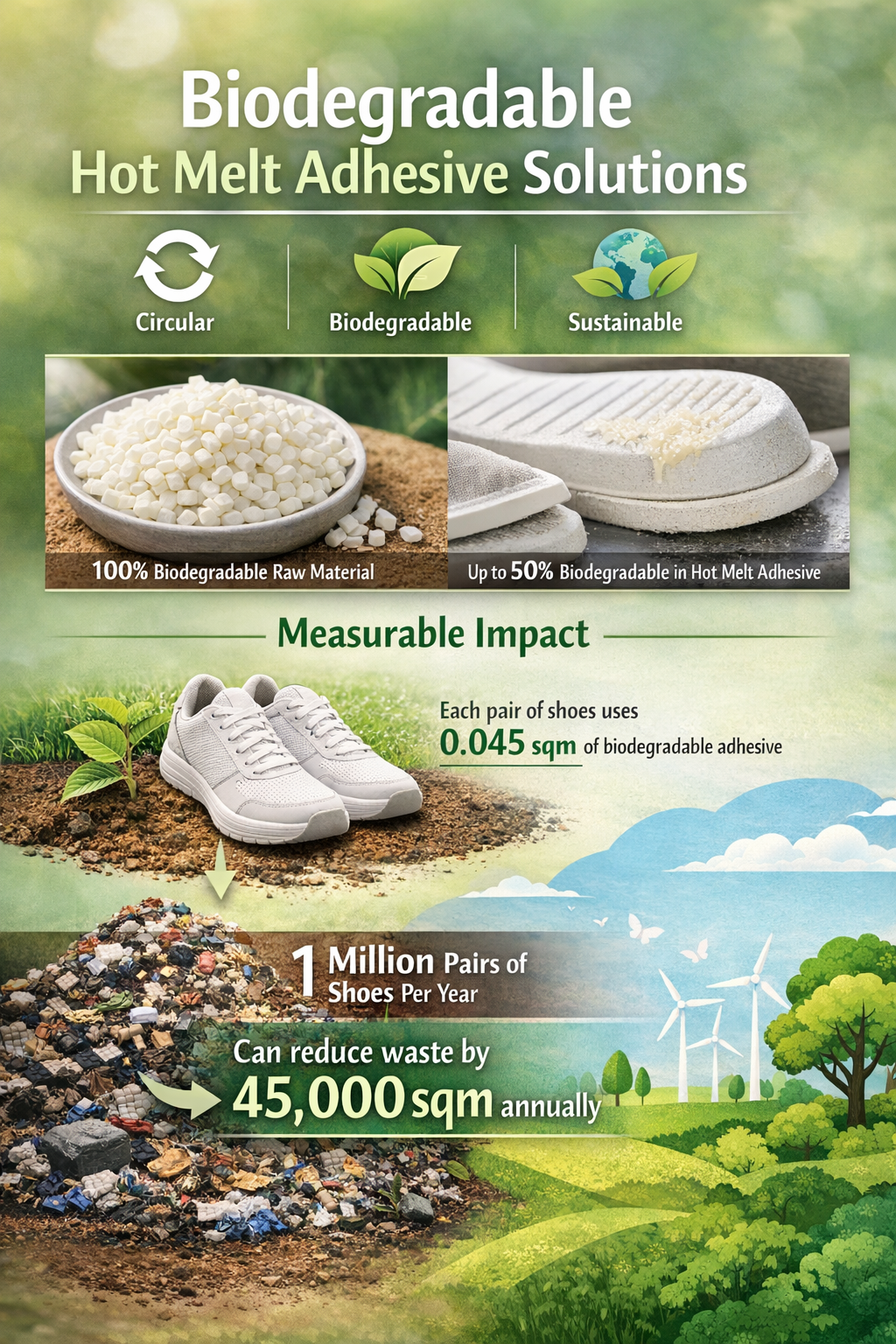
Microbial biodegradable hot melt adhesive refers to a type of hot melt material whose molecular structure can be gradually broken down by microorganisms under specific environmental conditions (such as soil, composting, or microbial-active environments), eventually converting into carbon dioxide, water, and biomass.
With our current technology:
-
Raw material level: up to 100% microbial biodegradability
-
Finished hot melt adhesive system: up to 50% biodegradable content, while maintaining industrial performance requirements
This ratio represents an optimized balance between adhesion strength, durability, and processing stability, ensuring the material remains suitable for mass footwear production.
2. Circular Economy Perspective: From Linear Consumption to Material Return
Conventional footwear hot melt adhesives are largely petroleum-based and difficult to degrade after use, ultimately ending up in landfills or incineration systems, creating long-term environmental burden.
By introducing microbial biodegradable hot melt adhesives, the material life cycle can be fundamentally redefined:
Raw material sourcing → Product use → Microbial degradation → Return to natural cycles
Within a circular economy framework, this enables:
-
Reduced dependence on non-renewable fossil resources
-
Lower long-term material residue in the environment
-
A foundation for future recyclable and biodegradable footwear systems
3. Biodegradability with Measurable Environmental Impact
Sustainability should be quantifiable, not just conceptual. Below is a practical example illustrating the environmental value of microbial biodegradable hot melt adhesives using real application data.
Adhesive Usage per Pair of Shoes
For typical footwear structural applications:
-
Biodegradable hot melt adhesive usage per pair: approximately 0.045 square meters (sqm)
-
Biodegradable content in the adhesive system: 50%
Annual Waste Reduction Example
Assuming a footwear brand with an annual production volume of:
-
1,000,000 pairs per year
The calculation would be:
-
Total annual hot melt adhesive area used:
-
0.045 sqm × 1,000,000 = 45,000 sqm
-
-
Biodegradable portion:
-
45,000 sqm × 50% = 22,500 sqm
-
This means that approximately 22,500 square meters of adhesive material per year will no longer exist as persistent waste in the environment.
When scaled across multiple brands and production regions, the cumulative environmental benefit becomes substantial.
4. Green Upgrade Without Sacrificing Performance
In footwear manufacturing, hot melt adhesives are not merely bonding agents; they are an integral part of the structural performance system, directly affecting:
-
Shape retention and molding stability
-
Peel and bonding strength
-
Fatigue resistance and aging performance
-
Compatibility with automated production lines
Our microbial biodegradable hot melt adhesive solutions:
-
Maintain reliable structural performance at 50% biodegradable content
-
Are suitable for applications including:
-
Heel counters
-
Toe puffs
-
Local reinforcement and structural bonding zones
-
This allows brands to advance sustainability goals without compromising product quality or manufacturability.
5. A Forward-Looking Sustainable Footwear Material Solution
As global regulations, brand ESG commitments, and consumer awareness continue to evolve, biodegradable materials are becoming an industry expectation rather than a niche innovation.
Microbial biodegradable hot melt adhesives represent a critical step forward:
-
Delivering practical and scalable sustainability solutions
-
Providing brands with measurable and communicable environmental value
-
Reducing long-term material burden on ecosystems
True sustainability is not about sacrificing performance, but about using smarter materials to create products that perform just as well—if not better—while leaving a lighter footprint on the planet.
For more information on application-specific solutions across different footwear categories and structural components, please feel free to contact us to explore a greener future together.